512 passages · 20 books · English, Hanzi, & Pinyin
Now on the App Store
Analects Reader for iPhone and iPad
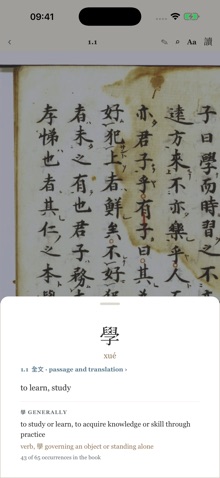
The whole book, offline: every character tappable with its reading for that passage, colour match between the Chinese and the English, and three photographed classical copies — a Qing court manuscript, a scholar's copy of 1550, an Edo printing — with every character on the page mapped, so a tap works on the manuscript as it does here.
 Free. No account, no ads, no tracking.
Android is in closed testing — join the beta on Google Play →
Ways to read it
Each opens the text set up for one kind of reading. Everything stays adjustable afterwards.
The Complete Text
All 512 passages, switchable between traditional and simplified characters. Toggle pinyin on or off, hover any character for its classical definition, and search across the whole work.
Open the text →Translations
Every passage sits beside an English rendering, with the translator named on the page. Legge's 1861 translation covers the complete work.
See translations →Commentary
42 passages across 27 episodes — the textual problems, the commentarial disagreements, and the history behind them.
Browse commentary →虛詞 Function Words
The little words that hold Classical Chinese together — 之, 也, 而 and their kin — each explained in plain language, counted across the book, and shown word-matched against its translations.
Study the particles →Browse by Book
The Analects of Confucius is arranged in twenty books, each traditionally named after the opening words of its first passage.
Translations on This Site
Every English rendering is attributed to its translator on the passage page. Where a passage has been treated in an episode, the translation used in that episode is shown alongside.
How the definitions were made
A dictionary gives a character one entry and leaves you to pick the sense. This gives each character its own definition in each of the 512 passages, so 說 in 1.1 reads pleased, delighted — a loangraph for 悅 — and not to speak. There are 15,920 such definitions, one for every Chinese character in the book.
Characters that form a word are glossed as the word: 11,640 terms and phrases, including frames whose parts are not adjacent — 不亦…乎, is it not…? — which no character-by-character reading can show. 187 carry a note where the reading is not the obvious one, and 838 record that no translator renders them as a separate English word at all, because a particle's work is done by English sentence structure rather than vocabulary.
On top of that sits a sense inventory for the 250 commonest characters and terms — 445 generalised senses in all — so a character can answer both questions at once: what it is doing here, and what it does across the book. 10,612 of the definitions are joined to one.
Each was written by reading eight English translations of that passage side by side, against a standard character dictionary. Where the translators diverge, the reading they mostly share leads and the alternatives are kept and labelled rather than blended in — one translator's house style is not a distinct sense of a term. The definitions are revised as errors are found, and corrections reach this site and the app without either being rebuilt.
Machine-assisted throughout, and read against the translations rather than against the commentarial tradition directly. Treat it as a careful reading aid, not as scholarship to be cited.
The translations consulted
- Ames, Roger T., and Henry Rosemont Jr., trans. The Analects of Confucius: A Philosophical Translation. New York: Ballantine Books, 1998.
- Chin, Annping, trans. The Analects (Lunyu). Penguin Classics. New York: Penguin Books, 2014.
- Lau, D. C., trans. Confucius: The Analects (Lun yü). Penguin Classics. Harmondsworth: Penguin Books, 1979.
- Legge, James, trans. The Chinese Classics, Volume I: Confucian Analects, The Great Learning, and The Doctrine of the Mean. London: Trübner & Co., 1861. Revised second edition, Oxford: Clarendon Press, 1893.
- Ni, Peimin, trans. Understanding the Analects of Confucius: A New Translation of Lunyu with Annotations. SUNY Series in Chinese Philosophy and Culture. Albany: State University of New York Press, 2017.
- Roberts, Moss, trans. The Analects: Conclusions and Conversations of Confucius. Berkeley: University of California Press, 2020.
- Slingerland, Edward, trans. Confucius: Analects, with Selections from Traditional Commentaries. Indianapolis: Hackett Publishing, 2003.
- Watson, Burton, trans. The Analects of Confucius. Translations from the Asian Classics. New York: Columbia University Press, 2007.
Commentary
42 passages examined in detail across 27 episodes of Exploring the Analects. Each includes the original Chinese, a translation, the philosophical argument, and notes on the language.
Don't be a Tool
Confucius explains how to put your capabilities to good use. Learn about the concept of 君子 and why broad learning matters.
Teachers Aren't Gatekeepers
Confucius's revolutionary approach to education. Learn about 有教無類 and why teaching should be accessible to all.
Calling Shotgun
Explore seating preferences and social hierarchy in ancient China through Confucius's habits.
The Art of the Straight Shooter
Confucius on the purpose of language and the distinction between words that communicate and words that manipulate. Analects 15.41.
Won't you be my neighbor?
Explore the concept of 德 or moral charisma and how virtue naturally attracts community.
The Corner Office
Learn about leadership qualities and meritocracy through Confucius's praise of his disciple Yong.
Somebody Needs a Vacation
Three passages on mindful living — Confucius's habits around eating, sleeping, and visiting the temple. Analects 10.10, 10.21, and 10.24.
Disclaimer: Serving Suggestion
Learn about four qualities that Confucius considered prerequisites for human-heartedness: resoluteness, grit, simplicity, and sincere speech.
You're Out There in the Trenches
Learn about moral charisma (德), meet Confucius's warrior-disciple 子路, and explore the chaotic Spring and Autumn period of Chinese history.
Winner Takes All
Confucius on when to disobey superiors, why rigid honesty can be a moral failing, and the difference between petty fidelity and true discretion.
The Village Worthy
子曰:「未可也。」
「鄉人皆惡之,何如?」
子曰:「未可也。不如鄉人之善者好之,其不善者惡之。」
Learn about the village worthy (鄉愿), why Confucius considered a spotless reputation dangerous, and what it really means for the right people to approve of you.
Hiding Behind a Smile
Why Confucius distrusted charm: meet Prince Chao and Priest Tuo of Wey — the pretty boy and smooth talker — and explore the difference between 佞 and 仁.
In Days of Old When Kings Were Bold
子貢曰:「文武之道,未墜於地,在人。賢者識其大者,不賢者識其小者,莫不有文武之道焉。夫子焉不學?而亦何常師之有?」
Confucius's quest to revive the Way, Daoist vs. Confucian visions of 道, and why Zigong said the Master needed no single teacher. Analects 4.8 & 19.22.
Golden Handcuffs & Pearls Before Swine
子曰:「沽之哉!沽之哉!我待賈者也。」
Confucius on wealth, work, and knowing your worth — plus meet the Mohists, ancient China's sharpest critics of Confucianism. Analects 7.12 & 9.13.
Is Greed Ever Good?
Is Confucius against profit? Two Book 4 passages take on a common misconception — revealing a nuanced view of wealth, advantage, and acting appropriately.
A River Without Banks is a Swamp
What is ritual for? Confucius cared less about jade, silk, bells, and drums — more about the bonds participation creates. Analects 4.23, 12.15, 17.11, 3.12.
Don't Call a Tail a Leg
A ritual vessel passage becomes a meditation on why names matter. When people mislabel things, the values those names protect start to erode. Analects 6.25.
No Undo Button for Life
Ritual cleansing, warfare, and illness — Confucius treated all three with absolute gravity. Why? Because some mistakes cannot be undone. Analects 7.13.
Bronze-Age Clickbait
Confucius refused four topics: strange events, feats of strength, rebellion, and spirits — each a spectacle pulling attention from the real work of a good life.
Relative Dysfunction
A passage calls Lu and Wey 'brothers.' Two thousand years of commentary argue about what it means — and 朱熹 refused to choose.
Parting Ways
A line Chinese speakers still use to tell someone it's time to part ways. But did Confucius mean you can't plan with people unlike you — or that you shouldn't?
The Side Quest Trap
A warning about the cost of detours — which later readers turned into a mandate to hunt down heresy.
Love and Hate
Two neighboring passages that seem to contradict each other, and the one character that decides whether they do.
Sitting Shiva with Confucius
Two passages on how Confucius behaved around the bereaved, and why the rites bound grief instead of just prescribing it.
A Pleasure to Have in Class
Confucius taught four things. Two could be studied and drilled; the other two he could only live in front of his students and watch for over the years.
Mind Your Own Business
Confucius forbids planning what isn't your job, and Zengzi forbids even thinking past it. The same line sits in the Book of Changes, and the commentators spent centuries making room inside it.
Fear of the Unknown
Confucius praises the love of learning in a scheming minister of Wey. Study with urgency, he says, but why you study decides what the learning is worth.
About
The Analects of Confucius (論語) was compiled by followers of the Confucian way between the 5th and 3rd centuries BCE. It is not a treatise but a record — arguments, jokes, grudges, and moments of grief among a real teacher and his students, along with the two thousand years of commentators who have fought over what every line means.
This site hosts the complete text alongside translations and commentary. The commentary also exists as Exploring the Analects, a podcast and video series hosted by Elliott Bernstein.