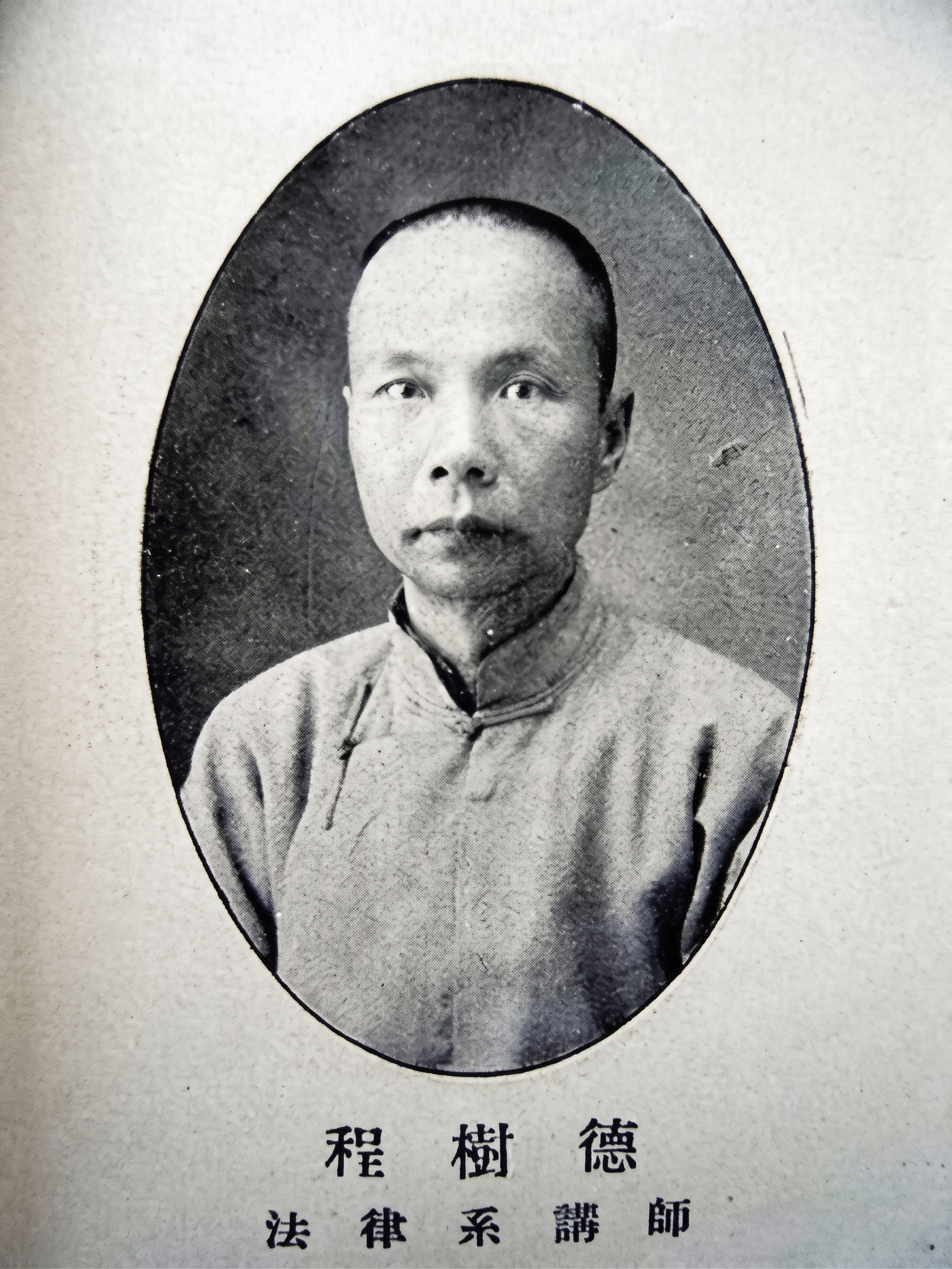
The source of the commentary
程樹德 Chéng Shùdé
1877–1944
The commentators' disputes, their verdicts and the notes on the text on this site all come from one book: 論語集釋 Lúnyǔ jíshì "Collected Interpretations of the Analects", compiled by Cheng Shude and printed in 1943.
His life
He was born in 閩侯 Mǐnhóu, today's 福州 Fúzhōu in Fujian. He passed the provincial examination in 1903 and studied law at Hōsei University in Tokyo. In 1908 the court gave him the metropolitan degree it granted students back from abroad, and a post as compiler in the 翰林院 Hànlínyuàn "Hanlin Academy".
Under the Republic he was a jurist and a historian of Chinese law. He taught at Peking University, at Tsinghua and at the law school of Peiping University, and sat in the Republic's legislative councils. His legal histories, 九朝律考 Jiǔ cháo lǜ kǎo "Studies of the Laws of Nine Dynasties" and 中國法制史 Zhōngguó fǎzhì shǐ "A History of Chinese Law", are still read.
He spent his last years in occupied 北平 Běipíng, poor and paralyzed. In his own words, for seven years he could neither walk nor speak. He worked on with members of his family, who wrote the book out for him, and finished it in 1942 after nine years. It was printed in 1943, the year before he died.
The book
Forty juan, quoting some 680 earlier works. He prints each passage of the 論語 Lúnyǔ "Analects", or each clause of a long one, and under it sets out what the tradition has said, sorted into kinds of note, with his own comments marked 按 àn.
Because he quotes everyone and then says what he thinks, the book is two things at once: a library of two thousand years of readings, and one careful reader's judgment on them. Where the site says "Cheng Shude's verdict favors…", it means one of his 按 comments.
The kinds of note, in the order he prints them
- 考異 kǎo yì Textual variants
- Where the old copies disagree about what the text says: a character one edition has and another lacks, or writes another way. It comes first, because nothing else can be settled until the words are.
- 音讀 yīn dú Readings and punctuation
- How a character is read aloud, and where a sentence breaks. The text records neither, and either one can change what a passage means.
- 考證 kǎo zhèng Evidence
- Facts from outside the Analects that bear on a passage: who a person was, a place, a rite or an office, a parallel in another early book.
- 集解 jí jiě The Collected Explanations
- 何晏 Hé Yàn's 論語集解 Lúnyǔ jíjiě, from about 249, the oldest commentary on the Analects to survive whole. It gathers the Han commentators, 孔安國 Kǒng Ānguó, 包咸 Bāo Xián, 馬融 Mǎ Róng and 鄭玄 Zhèng Xuán among them.
- 唐以前古注 táng yǐ qián gǔ zhù Commentary from before the Tang
- Mostly 皇侃 Huáng Kǎn's 論語義疏 Lúnyǔ yìshū of the 6th century, and the earlier readers it quotes. It was lost in China and came back from Japan in the 18th century, with readings the later tradition had forgotten.
- 集注 jí zhù The Collected Commentaries
- 朱熹 Zhū Xī's 論語集注 Lúnyǔ jízhù of 1177. From 1313 to 1905 the civil examinations followed it, so it is the reading most later scholars learned first, and the one the others argue with.
- 別解 bié jiě Other readings
- Readings that differ from both He Yan and Zhu Xi. A reading is here because it is a real alternative, not because it is wrong. Where there are several, they are numbered.
- 餘論 yú lùn Further discussion
- Later remarks worth keeping. They bear on the passage without settling how to read it.
- 發明 fā míng Bringing out the meaning
- What the passage asks of a reader: what it means for conduct and self-cultivation, not what its words mean. 發明 here is the old sense, "to bring to light", not "to invent".
- 按 àn Cheng Shude's own comment
- Cheng Shude speaking for himself, usually to judge between the readings he has just set out.
How this site uses it
The disputes. Where the book records readings that differ, the passage page sets them out under "What the commentators say", oldest first, each under the commentator who holds it, with his verdict where he gives one. Each dispute opens when you click it.
The camps. The site also groups each dispute's readings into camps, and calls the dispute a deep divide, a minor split, an outlier or a nuance. That grouping is the site's own, made with machine help, and it is not Cheng Shude's.
The notes. The notes on each passage are drawn from the same book. Their quotations were checked against the first printing of 1943.
The English. The summaries and translations are the site's own, made with machine help, and they are not yet fully reviewed. Rely on the Chinese quoted with each one, and use the report link under it when something looks wrong.
His full text. The site doesn't reproduce the book itself. The Analects app has his whole Chinese text under each passage, with every kind of note above labeled.
Sources: the Chinese Wikipedia article on 程樹德, and the preface to the modern edition of the book.